An Elegantly Simple Explanation of Temporomandiular Joint Disorder (TMJ)

I do not often “borrow” from my colleagues, but a Fellow from the Institute where I study, Dr. Scott Tamura, has created a video to help his patients to understand Temporomandibular Joint Disorder (TMD) and I absolutely love its simplicity. It’s called “TMJ FOR DUMMIES” and can help anyone to understand the fundamentals of this condition which I have spent years studying and attempting to explain to patients.

Click the link to view the video: TMJ For Dummies

For those who suffer with headaches, jaw discomfort or uncomfortable bites due to TMD, we offer relief and a feeling of renewed well-being because we use state-of-the-art technology and non-invasive techniques to relax aching muscles and return the jaw to a physiologically comfortable position. So, enjoy the show, and please feel free to call me if you have additional questions or would just like more information. I wear one of these orthotics myself and can give you a first hand account of how much it has helped me.

Feel free to call me at 908.359.6655 or via our website at www.DesignsForDentalHealth.com.

NOTE: Originally posted November 14th, 2011

Sleep Apnea and Sleep Disorders

Sleep Apnea and Your Health

Do You Sleep as Well as You’d Like?

Sleep Apnea and Sleep DeprivationRoughly 20% plus of our patients do not! The reasons for this lack of quality sleep range the gamut from emotional to physical, and the variety of sleep disorders is as long as it is fascinating. No matter the cause or the disorder, whether sleep apnea, insomnia or a range of other sleep disorders, people need a regular and appropriate amount of restful sleep to stay healthy. Those who do not sleep well will eventually exhibit symptoms of sleep deprivation and directly associated health issues.

What Are The Health Risks?

  • Heart disease and strokes
  • High Blood Pressure especially when difficult to control
  • Adult Onset Diabetes
  • Depression and anxiety
  • Memory loss and impaired concentration
  • Obesity
  • GastroEsophageal Reflux Disease (GERD)
  • Daytime Sleepiness

Questions to Ask Yourself

Do you have any of the conditions listed above?

Do you feel like you need more sleep when it’s time to get up in the morning?
Do you feel very sleepy during the day?
Have you been told that you snore?
Do you ever wake up at night choking or gasping?

Many of our patients who answered “yes” to more than one of these questions and were appropriately screened for sleep issues have had these issues resolved — they are living healthier lives and feeling great!

How Can We Help? Sleep Apnea and Dental Screenings


Sleep Apnea and Sleep Deprivation
Dentists have the perfect opportunity to help every time you visit them. The major sleep issue to which we have been alluding is called Obstructive Sleep Apnea (OSA). OSA is an AIRWAY issue, and every time you open your mouth in the dental chair, your dentist is looking down your airway! Dentists trained in Dental Sleep Medicine can easily screen you for Obstructive Sleep Apnea and guide you if additional steps are needed and where to get them.

Our entire team not only has the necessary training, but the belief that it is our responsibility to help our patients be as healthy and comfortable as they can be. So, all patients who come for an examination receive an OSA screening! The screening includes a comprehensive questionnaire, evaluation of the airway and a consultation about our findings. And, we’ll even extend this offer to your friends, family and coworkers.

We are excited about all that we have been learning about Obstructive Sleep Apnea and, for the first time in our history, the potential to actually save lives.

Simply call our office @ (908) 359-6655 or visit our website @ www.DesignsForDentalHealth.com to make a cleaning and examination appointment that includes your screening. As always, feel free to call or email us with any questions you may have about OSA or dentistry.

What You Need To Know About Oral Cancer

Basic Description of Oral Cancer

Cancer can affect any part of the mouth including the lips, gums, cheeks, tongue and hard or soft palate. The most common symptom of cancer is a sore in the mouth that bleeds easily and does not heal. Another common sign of oral cancer is pain or numbness, which does not go away, or a change in the way the teeth fit together. Other signs and symptoms of oral cancer include:

-A lump or thickening in the cheek
-A white or red patch on the gums, tongue, tonsil or lining of the mouth
-A sore throat or a feeling that something is caught in the throat
-Difficulties in chewing, swallowing, speaking or moving the tongue or jaw
-A color change of the oral tissues

Who is at Risk?

Close to 37,000 Americans will be diagnosed with oral or pharyngeal cancer this year. It will cause over 8,000 deaths, killing roughly one person per hour, 24 hours a day. Of those newly diagnosed individuals, only slightly more than half will be alive in five years (around 57%).

Gender – Oral cancers are about twice as common in men than women. This is because men are more likely to use tobacco and alcohol over long periods of time and in large enough quantities to cause these cancers.

Age – The likelihood of developing oral cancer increases with age, especially after age 35. Half of all oral cancers are diagnosed in people older than 62.

Tobacco and Alcohol – About 80% of patients with oral cancers use tobacco. The risk of developing these cancers increases with the amount smoked or chewed and the duration of the habit.

About 70% of al patients with oral cancers drink alcohol frequently. These cancers are much more common in drinkers than non-drinkers.
The combination of smoking and drinking heavily raises a person’s risk much more than either by itself.

Sun Exposure – Many patients with cancers of the lip have outdoor jobs associated with prolonged exposure to sunlight.

Diet – A diet low in fruits and vegetables is associated with an increased risk of developing this cancer.

HPV Infection – According to a recent article in Time (October 5, 2011), the number of head and neck cancers linked to the sexually transmitted human papilloma virus (HPV) has increased sharply over the past two decades. This virus may account for more cancers than tobacco or alcohol, a new study finds. Overall, the risk was greatest and rising in men. HPV is best known as the virus that causes cervical cancer in women, but because of better screening, the rate of such cancers has declined. The good news is that patients with HPV-positive oral cancers have better survival rates than those with cancer due to other causes, possibly because their tumors have less genetic damage, which makes them more responsive to treatment.

Bottom Line

One of the real dangers of this cancer is that, in its early stages, it can go unnoticed. It can be painless, and few physical changes may be obvious. The good news is that your dentist or doctor can, in many cases, see or feel the tissue changes, or the actual cancer while it is still very small, or in its earliest stages. It may appear as a white or reed patch, or a small ulcer similar to a canker sore. Because so many benign changes occur in the mouth, it is important to have any sore or discolored area of your mouth, which does not heal in 14 days, looked at by a professional. Other symptoms include: a lump or mass which can be felt inside the mouth or neck, pain or difficulty swallowing, speaking, or chewing, any wart-like masses, hoarseness which lasts for a long time, or any numbness.

The only way to know for sure is to do a biopsy of the site. This procedure is not painful or expensive, and takes little time. It is important to have a diagnosis as early as possible, and your medical doctor or dentist may refer you to a specialist to have the biopsy performed.

Conclusion

Most oral cancers could be prevented if people did not use tobacco or drink heavily. Quitting tobacco and limiting alcohol use sharply reduces any risk of developing oral cancer, even after years of use. Many oral cancers may be found early by a combination of routine screening exams by a doctor or dentist or by self-examination.

NOTE: Originally posted October 14th, 2011

Dr. Nadler Speaks on Dental Appliances for Sleep Apnea Treatment

Options for Sleep Apnea Treatment Presented at Sleep for Life Event

Dr. Nadler at Sleep for Life event

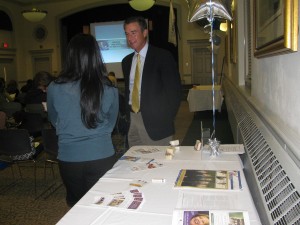
Dr. Nadler spoke to participants about sleep apnea treatment with dental appliances.

Dr. Nadler was recently invited to give a lecture on Oral Appliance Therapy (OAT) for the treatment of Obstructive Sleep Apnea (OSA) at the Somerset Medical Center. He was invited to speak by the medical team at Sleep For Life in Hillsborough, who organized the event in celebration of Sleep Technician Appreciation Week. All speakers presented options for sleep apnea treatment.

Over fifty people were in attendance at the event, including members the Somerset Snoozers Sleep Support Group, Sleep for Life sleep technicians, medical and office staff, Somerset Medical Center staff and invited doctors.

Dr. Nadler described the SomnoDent and Herbst dental appliances, used at Designs for Dental Health for sleep apnea treatment. He spoke about who could benefit from Oral Appliance Therapy and what features are important in choosing a dental appliance. After the presentations, event participants were able to view models of the appliances and ask Dr. Nadler questions about how they function and their use for OSA treatment.

Dr. Nadler educates participants about sleep apnea treatment options using dental appliances.

Dr. Nadler educates participants about sleep apnea treatment options using dental appliances.

Other presentations included a lecture on surgical solutions for Obstructive Sleep Apnea by Drs. Adrianna Hekiert and Amy Lazar of ENT & Allergy Associates as well as an overview of sleep disorders by Dr. Namita Joshi, Medical Director at Sleep for Life.

Dr. Nadler and the team at Designs for Dental Health give a special thank you to David Orloff, Robert MacAffrey and AnnaMarie Bordonaro from Sleep for Life for their invitation to participate in the event, the staff at Sleep for Life for their warm welcome and our dental appliance reps from Christina LaJoie at Great Lakes Orthodontics (Herbst appliance) and Courtney Snow at SomnoMed (SomnoDent appliance) for their contribution of materials for the event.

Read more about symptoms and treatment of Obstructive Sleep Apnea at Designs for Dental Health

See more photos from the event! (NOTE: You must sign in and “like” us on Facebook first!)

Have questions for Dr. Nadler about sleep apnea treatment with dental applicances? Submit it on the form to the left of this article and Dr. Nadler will be in touch by e-mail within 24 hours!

NOTE: Originally posted October 7th, 2011

SOMNODENT Dental Sleep Apnea Appliance: A Patient’s Experience

Sleep Apnea Appliance: What our Patient Thinks

Sleep apnea treatment using dental appliances repositions the tongue and jaw down and forward to keep the airway open during sleep. SomnoDent is a dental appliance we use at Designs for Dental Health for sleep apnea treatment. The SomnoDent company claims that you won’t find a more comfortable sleep appliance.Recently, we had the opportunity to speak with one of our patients who made the switch to a SomnoDent dental appliance from another brand about her experience in making the switch and she confirmed this, stating that there was no comparison between her new Somnodent and her old dental appliance. Our patient stated that she LOVES her new appliance and is happy with all aspects of the product, from the comfort to the quality to the color.

In all, our patient is very satisfied with her Somnodent appliance and that makes us happy! Want to learn more about sleep apnea treatment using dental appliances? Give us us a call at 908-359-6655 to set up a consultation with Dr. Nadler.

Sleep Apnea Treatment with Dental Appliances

Dr. Nadler offers relief from sleep apnea using a custom oral appliance which repositions the tongue and jaw down and forward to keep the airway open. Comfortable and easy to use, this appliance can be worn alone or in conjunction with a CPAP device to allow patients to sleep all night and wake up feeling refreshed. It is especially helpful for those with mild to moderate OSA, patients who have difficulty using CPAP, and those who travel and do not wish to transport their CPAP.

NOTE: Originally posted October 6th, 2011

Top 10 Reasons To Have a Dental Exam and Cleaning This Month

1. You’ve been getting hints that your breath is a problem.
2. You see some blood after brushing or flossing.
3. It’s a little known way to prevent HEART ATTACKS and STROKES.
4. Maria, our hygienist, loves to get rid of those ugly stains.
5. You have a sensitive area and wonder if there’s a problem.
6. People who have regular dental care save lots of $$ on their dental bills.
7. Your insurance benefits – use ‘em or lose ‘em.
8. To be screened for oral cancer which is highly curable IF DETECTED EARLY.
9. Those who have their regular exams and cleanings this month receive a voucher for $300 off a BriteSmile in-office tooth whitening.
10. And, the number 1 reason to have a dental exam and cleaning this month is:

It’s been a LOOOONG time since your last visit.

If you wish to schedule your exam and cleaning or have any questions,please call us at 908.359.6655 or email to info@DesignsForDentalHealth.com

NOTE: Originally posted May 5th, 2011

Dr. Nadler is featured in NJSavvy Living Magazine, Snoring and Sleep Apnea, and the K-7 Occlusal Evaluation System

It has been a while since my last post, and there have been some major developments in the practice during that time. This article is meant to bring you up to date; and, then, I plan to write blogs on a more regular schedule to explain in detail exactly how these improvements will help our patients.

I am also putting the finishing touches on a “Cosmetic Checklist” to assist patients in determining if they are candidates for cosmetic procedures, and specifically what issues need to be addressed. This checklist should prove very informative for patients, and allow them to become more involved in the process of developing an appropriate treatment plan for themselves. This checklist should be ready in a week or two, and, at that time, I’ll provide an overview of it on this blog as well as details of how to obtain a copy.

First, Tracy Ivie of NJSavvy Living Magazine interviewed me for the Annual Health and Beauty issue. In the article entitled “The Teeth Have It”, current trends in cosmetic dentistry ranging from whitening to implants to complete smile makeovers were explored. In the article, one of our cases was featured to demonstrate the dramatic results which can be attained using up-to-date techniques and technology. I was quoted on a variety of subjects including the importance of establishing underlying dental health before any cosmetic procedure is initiated. As you may imagine, this experience was very gratifying on a professional level. I believe that this issue of the magazine is currently on your newsstands…

Second, our team has taken advanced training in snoring and sleep apnea. This subject has proved fascinating for us, as we have always been concerned with the airway issues of our patients, especially the young ones. Patients often ask why we ask about snoring or allergies or sore throats. Such questions are meant to uncover any airway issues which may have a detrimental effect on their bites. Mouth breathing, large tonsils, large tongues, high or deep palates, improper baby bottle or pacifier shape or usage are some potential causes of malocclusion (bad bites) as well as snoring and sleep apnea. We now have a new understanding of how integrally related are the airway and the mouth and the bite. More importantly, we learned that most people with nighttime breathing issues are unaware of their problem. And, some of these patients have a potentially life-threatening condition. Many others have been diagnosed with sleep apnea and have been treated for their illness with a CPAP (continuous positive airway pressure) machine which forces air through their nose while sleeping to maintain an open airway. Unfortunately, roughly ninety percent of such patients stop using this device after the first year for a variety of reasons which places them at risk. Fortunately for these patients, alternative dental devices have been developed which help relieve snoring and sleep apnea by repositioning the jaw to reduce or eliminate closed airways. There are a variety of such appliances which are chosen based upon each patient’s individual circumstances.

Finally, we have a fantastic new technology in our office called the K-7 Evaluation System. This device measures and records jaw function and muscle activity through the computer, and provides critical diagnostic information to assist in our neuromuscular restorative dentistry. In addition, using joint sonography, the K-7 provides data about vibrations occurring in the temporomandibular (jaw) joint to evaluate the status of the joint and its cartilage disk function. Using multiple sensors, jaw movement can be tracked and analyzed. And, with a series of electrodes, we can observe jaw muscle activity and truly determine when the muscles are tensed and when they are at rest. This information is invaluable in treating TMJ problems as well as in determining the best position at which to restore a bite. This technology is totally comfortable for the patient and provides a series of on-screen displays which are easily understandable and amazing to witness.

So, now we are up to date with what is going on in the office. Thank you for your patience. I look forward to delving more into snoring and sleep apnea as well as the K-7 in upcoming blogs. If you have any questions pertaining to these or other dental concerns, please do not hesitate to call us @ 908.359.6655 or through our website at www.DesignsForDentalHealth.com.

NOTE: Originally posted April 17th, 2009

Cosmetic Dentist or General Dentist?

Before I begin, please forgive me if this blog entry seems a bit self-indulgent. I ran into a guy at the gym this morning with whom I have been acquainted for the past four or five years. He asked, as often happens, if I would mind talking professionally for a moment. Actually, I usually do enjoy talking shop outside the office, so I said “sure.” He proceeded to tell me that he has some cosmetic concerns about his teeth, knows some of my patients, and wondered if I would feel comfortable treating him since we know each other. He also said that he has a regular dentist who takes care of his routine dental needs. It occurred to me that I was not having a déjà vu, but had experienced this kind of interaction before. I assured him that I would not only feel comfortable seeing him, but, in fact, most of my best friends are patients. It seems that knowing a patient first, often eliminates any of the trust barriers that some new patients have.

So, “what’s the problem?” you ask. Well, I am always happy to hear that I will be seeing a new patient and was flattered that he liked the dental work of ours he had seen. But, later, on the way home, it occurred to me that I must have been sending out the wrong message somehow. That people frequently think that all I do is cosmetic dentistry, and, on top of that, that I may be too busy to accept new patients. Well, nothing could be further from the truth. Yes, I love doing cosmetic dentistry and have had the training to do very nice work. But, overwhelmingly, most of my work falls under the category of General Dentistry. I have enjoyed some patient families for twenty-five years. And, their care included the routine cleanings and exams, fillings, extractions, root canals, crowns, bridges, dentures and so on that general dentists do. In fact, there is no specialty designation of “cosmetic dentist.”

So, if you are already a patient, you probably know all this. And, if you are not, please be assured that I am a General Dentist who does accept new patients and provides a full range of dental care! As a matter of fact, the “FAGD” after my name stands for “Fellow of the Academy of General Dentistry.” I hope that this blog clears up any misconceptions and explains the initials after my name on which many have commented…

If you know anyone who will benefit from some general dentistry, we would certainly appreciate your kind referrals. Thank you for your indulgence, and, as always, please feel free to call the office at 908.359.6655 or email us at info@DesignsForDentalHealth.com.

NOTE: Originally posted February 10th, 2009

Everything You Need to Know About Tooth Whitening and Bleaching

Tooth whitening continues to be the most popular cosmetic procedure seen in most dental offices and this is especially true during the holiday season. Whiter teeth have become so popular, in fact, that a few years ago dental material manufacturers came up with a whole new range of “bleached” colors for their tooth-colored fillings, porcelains, and even denture teeth so that dentists could better match patients’ enhanced tooth colors. Compared to dental work which we placed some twenty-plus years ago, newer cases are definitely WHITE! Current patients initially requesting that their new dental work look “natural” overwhelmingly choose colors which would have seemed over-the-top only ten years ago.

Patients have two basic options when it comes to tooth whitening. First, there is “home” bleaching. This method involves wearing trays or strips for an hour or longer each day until the desired color is obtained. Some over-the-counter kits can be purchased at the grocery store or pharmacy. Other kits may be purchased from your dentist — we currently recommend TresWhite in our office. The over-the-counter kits can be very effective, but can take longer to provide an acceptable color change due to their lower concentration of the active ingredient as compared to those dispensed by a dental office. Also, the strips may not reach the back teeth as well as do the tray-type kits. When people smile the first molar can usually be seen, so coverage can be an issue.

These kits can range from about $25 for the strip-type kits up to about $100 for the dental office brands. Some offices offer a custom tray type kit into which a bleaching gel is placed. Such kits are more expensive, and our experience has been that the preformed tray kits like TresWhite are less expensive, just as effective, and more convenient.

Second, there is in-office whitening. We have been using the BriteSmile
System for many years with great success. The main difference between this technique and home bleaching is that the entire in-office process is completed in about and hour and a half. With this system, a protective barrier is first placed on the tissues surrounding the teeth. Then a whitening gel is placed on the teeth which is activated by a special light source for twenty minutes. The whitening gel is then removed, a fluoride desensitizing gel is placed, and the whitening gel and light procedure is performed for two or three additional twenty-minute sessions. Patients will see quite a marked improvement of color in one visit. The cost of this procedure is generally established by BriteSmile which frequently has “specials” in the range of $300 to $350.

Some patients have special tooth color issues. Tetracycline stains appear as bands of gray or brown along all the teeth as a result of injesting the medicine as a young child or by the mother carrying a fetus. Such stains improve with bleaching, but are not eliminated. To completely remove such stains, the teeth must be covered with porcelain or a tooth-colored filling material. Other patients display a single dark tooth as a result of root canal therapy. Such stained teeth generally respond very well to a conservative single-tooth bleaching procedure.

Finally, not all patients will benefit equally from any tooth whitening procedure. Yellowish teeth respond better than gray ones. And, excessively bleaching any teeth, especially grayish ones, will be counter- productive. Too much bleaching can actually remove too much color from the teeth causing them to look translucent. Such teeth display a dark appearance, as they no longer reflect light like normal teeth. Other patients wishing to improve their appearance would do better addressing issues other than color. Talking to a dental professional first can be enlightening regarding alternative treatments which may be more appropriate in some cases. The dentist will also determine if there are any reasons why bleaching may not be a good idea because of decay, tooth wear, tartar build-up, etc.

If you have other questions about tooth whitening or bleaching, you are welcome to call our office @ 908.359.6655 or email us at info@DesignsForDentalHealth.com.

NOTE: Originally posted on December 5th, 2008

A Truly Amazing Reconstruction

Last week, we began the last stage of a dental reconstruction which would not have been dreamed of when I was in dental school some twenty-five years ago. This patient has received the benefits of both new and old technology – i.e., implants and neuromuscular dentistry. She is a wonderful patient who has been eager to restore her worn teeth and replace her missing ones in spite of a long history of fearing dental work. My hat is off to her for her mental fortitude and willingness to do what is necessary to ensure such a great result!

This patient was originally motivated by a desire to improve the appearance of her smile. Her teeth had become so visibly worn that her front teeth were chipping and looked dark at the edges where they were so thin as to be transparent. She also had lost several back teeth long ago causing her jaws to become too close together. People with such bites develop creases at the corners of their mouth due to their being “over closed” and, in short, look older. In addition, just as the front teeth support the lips, the back teeth support the cheeks. Without the support of teeth, the lips and cheeks take on an unflattering sunken look — picture a denture wearer without his teeth.

After a thorough discussion of the alternatives for this patient, she decided to restore her worn teeth and replace her missing teeth with implants. In the process, her entire bite was reconstructed enabling the reposition of her jaw back to its proper position. The process involved her “wearing” a mock up of her finished new teeth for a period of three months before anything was done to her natural teeth. The mock-up (we call it an “orthotic”) was placed over her natural teeth and was not removable. The orthotic looks like regular teeth, and allows us to confirm that the new bite is comfortable, cosmetically pleasing, and will hold up to the forces of chewing.

After successfully wearing her orthotic for the prescribed period of time, we proceeded with the actual dental work. In this case, each arch (upper and lower) was completed in two visits, followed by carefully adjusting the bite to make sure that the “occlusion” was comfortable and stable. The implant-supported back teeth not only look natural, but allowed us to turn back the clock in amazing fashion.

Before and After

A Truly Amazing Reconstruction-Before and After

In this patient’s words:

“With having teeth which were missing and teeth that continued to chip away I knew that I needed extensive dental work.

Now that I am 90% completed, it was the best decision that I have ever made with an excellent result.

It was much easier and less painful than I imagined. I would highly recommend the dental procedure to anyone who is not pleased with their smile, or with the alignment of their teeth.”

If you have any concerns or questions about your appearance, bite or tooth wear, please feel free to call us to discuss your problem (908.359.6655) or you may email info@DesignsForDentalHealth.com. Also, you may check out the smile gallery on our website for other “before and afters.”

NOTE: Originally posted October 2nd, 2008