Gum Disease, Inflammation, and Your Health

All of our body’s organ systems are interconnected. What happens in one system can and often does affect other systems. One prominent and currently emphasized interrelationship is the one between periodontal (gum) disease and cardiovascular disease. And in particular, it is inflammation which is the common link between these two conditions.

Inflammation by itself is not a bad thing. Acute inflammation is the body’s normal response to injury and infection. This type of inflammation is experienced as redness, pain and swelling. Immediately after an injury, there is a biochemical reaction which improves blood flow to the affected area. Nerve and other cells send out signals to recruit white blood cells which help fight foreign bodies. This acute inflammation is absolutely necessary for normal good health.

There is another kind of inflammation which is our main concern in this article. That is chronic inflammation which is also known as low–grade or systemic inflammation. This inflammation is long–lasting and examples include autoimmune disorders like rheumatoid arthritis and lupus. In these cases the body mistakenly initiates an inflammatory response even though there is no actual infection or injury to be fought. Other examples of chronic inflammation include inflammatory bowel diseases like ulcerative colitis and Crohn’s disease.
periodontal-disease (1)


Chronic “hidden” inflammation occurs throughout the body when something engages the immune system. This engagement varies from person to person but may include repeated or prolonged infection, smoking and gum disease. Obesity also makes one prone to inflammation as fat cells turn out inflammatory proteins called cytokines. Most people don’t know that they are inflamed. There is a test which measures the inflammatory marker called the C–reactive protein but it is not used routinely to determine increased risk of associated diseases. The important point is that inflammation is the primary cause for most of our serious chronic diseases including cardiovascular disease, diabetes, cerebrovascular disease, rheumatoid arthritis, and Alzheimer’s disease to name but a few.

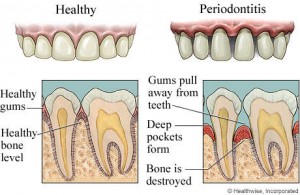
As far as the connection between gum disease and cardiovascular disease, research indicates that heart disease, clogged arteries, stroke and bacterial endocarditis may all be linked to oral health. Researchers believe that gum–disease–producing bacteria enter the bloodstream and make their way to the heart. And just as these bacteria create chronic inflammation and damage of the gums and bone around the teeth, the same bacteria can cause a similar response in the blood vessels. Inflammation can begin and accelerate the build-up of plaques with in blood vessels – called atherosclerosis or hardening of the arteries. These plaques decrease the flow of blood to both the heart and the brain, and if such a plaque breaks free can result in a heart attack or stroke.

periodontal-disease

What can you do? Roughly 75% of adults have some form of gum disease and 30 % have moderate to advanced periodontitis. Those with more advanced gum disease are much more likely to develop associated inflammation-related heart disease or stroke or the other inflammation-related illnesses. Having a thorough periodontal examination and following up with necessary gum disease periodontal therapy is the best first step. Avoid the obvious creators of inflammation which have been proven to be unhealthy. Prime examples are smoking and heavy drinking of alcohol.

There are many who advocate an “anti-inflammatory” diet. Many of the recommended foods would be typical of Mediterranean cuisine and certainly represent good nutrition. Such a diet would include:

• Generous amounts of fruits and vegetables

• Using healthy fats like olive oil

• Eating small portions of nuts

• Drinking red wine in moderation

• Eating fish regularly

• Limiting or eliminating red meat

If you would like more information about inflammation, gum disease and your health, please feel free to contact us by telephone at 908.359.6655 or via our website at www.DesignsForDentalHealth.com

Why We Love Spring!

After this long winter, with its record setting low temps and more snow storms than we could handle, it’s safe to say that we are all ready for some warm weather.  For some of us, it’s not just the change in temperature that get us excited for spring, but the activities and life that comes with it. Some of the staff at Designs for Dental Health took a brief moment to share why we love spring. See our answers below!

download (2)

Dr. Nadler:

 “Spring is definitely my favorite season. Everything comes back to life, brown turns to green, flowers start to bloom and everyone comes out of their winter funk.  Spring also means that the golf season will soon be under way.  That REALLY makes me happy.  And, spring is when days are getting longer giving us more daylight to enjoy the outdoors and just be alive!  I love spring.”

1545718_617712644943998_1694496779_n

Liz:

“I love spring because it means the cold weather is almost gone. It’s great to see everything getting green again. And most of all it’s one step closer to Summer!”

images


Maria:

 “I’m looking forward to spring because the weather is perfect.  It’s never too hot or too cold.  I can go on a bike ride with my family and spend more time being outside.”

download (3)


Remi:

“I Look forward to Spring every year! Especially after cold, long winters. But like all the seasons I find beauty in them all..(Fall is my favorite)

I love the colors that pop up everywhere you look, from the green grass to the leaf buds beginning to grow. I love how the air smells fresher almost cleaner, and you can’t help but enjoy the rebirth of almost forgotten flowers.

The poor confused crocus can finally come up and enjoy the sunshine! I don’t suffer from allergies (knock wood) and when I smell fresh cut grass it invigorates me! I love to watch the tulips that my daughter and I planted awaken from their long hiatus. And my daughter loves to pick me daffodils almost every other day. She tells me it’s because she loves me. I sometimes smile and reminisce of the first pedals/flower heads she used bring me when she was a toddler(the poor things). We are all grateful she is a more skilled gardener now. I love how even the department stores have all the vibrant colors on display!  And of course the Easter dresses and bonnets for the little ones. What is not to love about Spring?  And yes the “Golf” it’s a promise I made to myself…to get back on the course this year…with my husband.”

download (1)

 Allison:

“I love spring not only because the temperatures are near perfect, but because the warmer weather allows me to get outside and go for long runs, spend time horseback riding, and work on projects outside. I also look forward to watching the trees and flowers slowly come back to life.”

unnamed (3)


Why do you love spring? Let us know in the comments section below!!!

Oil Pulling – A Dentist’s View

I first heard about oil pulling several years ago when one of my more “holistic” patients asked about it. Recently, the subject has been raised with increasing frequency. “Oil pulling” is an ancient Indian folk remedy in which oil is used as a kind of mouthwash. This technique is touted to improve oral health as well as provide many incredible detoxification benefits.

What is oil pulling and how does it work?

A tablespoon of oil is placed in the mouth and is swished around the teeth for twenty minutes. During this swishing process, bacteria that are present on the teeth and soft tissues of the mouth become trapped in the oil. Certain bacteria like Streptococcus Mutans cause gingivitis and dental decay, and eliminating them certainly leads to improved oral health. After the twenty minutes, the oil is expectorated (spit out) into the trash, not the sink or the toilet so as to avoid causing a clog.

Various different oils are recommended. The original technique apparently called for sesame oil, but more recently there seems to be a trend toward using coconut and sometimes sunflower oil. It is very important that the oil not be swallowed as all the collected bacteria could lead to systemic illness if ingested. Some people recommend performing this technique every day, while others suggest that four to five times a week is adequate.

download images (1)images

So what are the professed benefits of oil pulling?

This technique acts as an antibacterial and antiviral system, and so detoxifies the mouth and indirectly the entire body. The potential benefits of this treatment include:

  • Whiter teeth
  • Healthier teeth and gums
  • Improvement of acne, eczema, psoriasis and other skin conditions
  • Clearing sinuses and helping allergy sufferers
  • Eliminating halitosis
  • Helping with general pain issues
  • And many more

Is there any truth to all of these claims?

As a matter of fact, there is reason to believe that this technique does provide detoxification benefits. This is one of a number of methods which can be used to clean the mouth so thoroughly that the body is better able to heal itself. Apparently there is a study which was published in 2008 in which oil pulling using sesame oil resulted in a significant reduction in Streptococcus Mutans after two weeks. However, this technique was not as effective as chlorhexidine mouthwash which is commonly recommended by dentists and periodontists to control gum inflammation. In addition, a serious limitation of this technique is that the oil only travels about one millimeter deep into the gums around the teeth, and the more damaging infections are more than three millimeters deep. This technique should not be used by people with active gum disease.

The most interesting thing about this technique is that it highlights the fact that as our oral health improves, so does our general health. Everything in the body is connected. So that improvement in the sinuses, the throat, the cardiovascular system, the skin and various other body systems is a very positive byproduct. When the mouth is healthier, the level of inflammation in the body is reduced, the body is better able then to heal, and we feel better and look better.

Oil pulling may be considered as an alternative to an excellent oral homecare regimen. Such a regimen would include brushing for two minutes twice each day and especially before bed, flossing between the teeth regularly, and perhaps using a WaterPik with an antimicrobial agent on a regular basis as well. Ideally people should have their dentist or hygienist recommend an oral care system specifically designed for him or her. In addition, nowadays we even have a DNA test which can determine specifically which bacteria are present in each patient’s mouth, and if they have the specific marker which might make them more susceptible to periodontal disease.

If you have any questions about oil pulling or would like information about developing a homecare regimen for yourself, please feel free to contact us by telephone at 908.359.6655 or via our website at www.DesignsForDentalHealth.com

Designs For Dental Health VIP Plan

Starting this month, we will be offering our Designs For Dental Health VIP Plan!!
vip
The Designs For Dental Health VIP plan* offers new and existing patients more affordable dental care on the most common and necessary dental services. This discount plan will save patients 15% off treatment fees for most of our services at no extra cost to you! In addition, there is no yearly maximum coverage limit, no deductibles, or waiting periods

What’s included in the plan?

  • 15%* discount on fillings, periodontal deep cleanings, crowns, bridges, implant crowns, dentures, extractions and root canal therapy.
  • Two regular exams per year, regularly $122.
  • Two regular cleanings per year, regularly $230.
  • All x-rays included with your cleaning visits, regularly up to $153
  • Oral Cancer screenings
  • One Fluoride treatment per year (up to age 16), regularly $48        (15% courtesy does not apply only to in-office bleaching or bleaching products, Invisalign Orthodontics, SixMonthSmiles Orthodontics, All-on-4 procedure, TMJ therapy, Sleep Apnea appliances, Arestin treatment, and full-arch or full-mouth rehabilitation)

With Designs For Dental Health’s VIP Program there are NO worries!

  • No yearly maximum coverage limit
  • No deductibles
  • No waiting period
  • No pre-existing condition exclusions
  • No ID cards necessary
  • No Insurance consultants

What is the cost of membership?

Only $325 for one entire year beginning on your registration date. That’s an automatic savings of up to $180 on your regular exams, cleanings, and x-rays alone!

images

Making high-quality dentistry even more affordable!

 Designs For Dental Health has many options to help you pay for quality dental care. We accept cash and checks. We even offer a 5% prepayment discount for all treatment prepaid in full with cash or check when scheduling a service, and when dental insurance isn’t being billed.  That means when you use the Designs For Dental Health VIP Plan and pay in full you can save 20% on treatment! 

We also honor Visa, Discover, MasterCard and American Express. And, we offer 0% financing (if paid in full over 12 months*) and flexible payment options through CareCredit and Springstone. For those with insurance, our team will file all your claims and work with you to receive the absolute maximum benefit from your dental insurance.

How do I sign up?

Come on into our office and we will be happy to sign you up ASAP! No appointment necessary, and new patients are always welcome. And if you have any questions about the Designs For Dental Health VIP Plan and would like to get more information, just ask us and we will be happy to help.

pic

Call us at 908-359-6655 or visit our website at www.DesignsForDentalHealth.com

*This plan is subject to change without notice

*Discounts cannot be combined with any other offers

*Fee discount is limited to 5% with any financing offer

Is It Really A Migraine??

Last week in the course of a routine examination, I asked a standard question of our young woman patient: “Do you have any problem with headaches?” She replied that she does have “migraines”. So I asked a few relevant questions about the headaches, and as is often the case, this patient’s answers led me to believe that her headaches are, in fact, not migraines.

imgres

In our office, we often treat patients with head and neck pain who have been diagnosed by their doctors as having temporomandibular joint dysfunction. Oftentimes, such patients visit their doctors because they assume that the headaches from which they suffer must be migraines.

What are the typical signs and symptoms of a migraine headache? A typical migraine may last several hours to as many as three days. The pain is moderate to severe, pulsating, and usually on one side of the head. Typical associated signs of migraines include nausea and/or vomiting, as well as sensitivity to light and noise. Many migraine patients describe an “aura” just before the migraine begins. Auras are exhibited as a change in vision or hearing. Episodic migraines occur fewer than fifteen times per month with only some of these headaches being actual migraines. Such headaches occurring more than fifteen days per month with pain lasting four hours or more over a three-month period are considered to be “chronic migraines”.

Migraines may be triggered by various factors, and three out of four migraine sufferers describe specific triggers. Common examples of these triggers are physical exertion, stress, hormonal changes, weather changes, and others.

Tension headaches are the most common primary headaches. Such headaches may be misdiagnosed as migraines and vice versa.

Cluster headaches are severe attacks of pain on one side of the head lasting between fifteen minutes and three hours. These headaches may occur every other day or as often as eight times each day. Cluster headaches may be associated with facial sweating, restlessness, agitation or nasal congestion.

Other types of headaches include those brought on by exertion or coughing.  They may be described as feeling like stabbing pain or other equally unpleasant feelings.

If you or someone that you know suffers from headaches, we can generally help determine whether or not migraine headache is a proper diagnosis. The determination is made based upon the patient’s history and description of the pain as well as a screening examination to rule out the possibility of TMJ-type pain. We even have a computerized evaluation system to diagnose which muscle or muscles may be causing the problem. Patients often find it hard to believe that their headaches may be related to their jaw joints or their bite. The truth is, the connection between head and neck pain and the muscles involved in moving the jaw as well as those holding the head erect are commonly the source of such pain.

images

If you have a question about headaches or would like additional information please feel free to contact us via our website www.DesignsForDentalHealth.com or by calling our office at 908.359.6655.

Cracked Tooth Syndrome – What You Need To Know

We have had several patients recently who have had problems related to cracked teeth. The symptoms of which these patients complain can be difficult for both the patient and the dentist.  Both can become frustrated because the underlying cause of symptoms is frequently difficult to pinpoint.  Often, patients will complain about pain which is caused by biting pressure and sometimes temperature.  It is frustrating for both parties because the described symptoms are often difficult to duplicate in the dental office.  It’s kind of like bringing your car to the dealer with a specific problem which suddenly vanishes as soon as you arrive at the dealership.

Cracked teeth generally occur for two reasons.  First, silver or amalgam fillings expand and contract as we consume hot and cold foods and beverages. The expansion and contraction of the filling is slightly greater than the tooth itself.  So, after years of such cycling in temperature-associated expansion and contraction, cracks frequently develop in the teeth.  Second, cracks may occur while chewing foods.  Commonly patients will describe a sharp pain in a tooth while they had been chewing, and the tooth will remain sensitive to biting pressure and/or temperature.

Cracked teeth are addressed in stages depending upon symptoms.  First, a bonded filling may be placed in an attempt to prevent the cracks from propagating further.  Depending on the depth and severity of the crack, an onlay or crown may be necessary to prevent the tooth from breaking.  An onlay covers any thin walls of the tooth which may be at risk for fracture and is considered a conservative, aesthetic and long-term restoration.  If the tooth has an extensive existing restoration or a more severe crack, then a crown which covers the entire tooth will be required to prevent the tooth from breaking.

In either case, the problem needs to be addressed as quickly as possible to prevent the crack from propagating further into the tooth leading to more severe dental problems.  For example, if the crack reaches the pulp of the tooth, then root canal therapy will be required as well.  The most severe complication would be the vertical tooth fracture which includes the root thereby making the tooth non-restorable.  In such cases removal of the tooth and replacement in some fashion will be required.

X00944

X04443

X00153_1

The important points to remember are as follows:

1. Determine the exact source of discomfort first

2. Address the symptoms as quickly as possible

3. Begin with the most conservative treatment and progress as needed to eliminate all symptoms

Such teeth need to be followed on a regular basis to ensure that damage to the pulp has not occurred.  Appropriate x-rays at routine intervals will be helpful for this.  Keeping your dentist apprised of precise symptoms will also go a long way to help in diagnosis.

If you have any questions about cracked tooth syndrome please do not hesitate to contact our office by calling 908.359.6655 or on the web at www.DesignsForDentalHealth.com

Expressions Of Gratitude From Members Of Our Team


The holiday season means different things to different people. For some, it may be that they look forward to celebrating and spending time with family and friends. For others, it may be a time for faith and devotion.

 We’re Reflecting On The Things We’re Most Grateful For…

Everyone on our team has taken some time to reflect on her (or his) life and to list some of the things we’re grateful for.  We want to share those thoughts with you!  FYI, there was no collusion amongst we participants…

 What we are thankful for:

 Dr. Nadler

richardpic

“I’m thankful for having found my wife, Elizabeth, thirty years ago!  And, for our many friends who provide our lives with so much joy and meaning.  And, finally, for my dental practice which has been my raison d’etre for three decades…”

Liz

photo

“I am most thankful to have found my best friend, my soul mate, my husband, Richard.”

April

image

“This year I’m most thankful for my family. Having a baby changes your life and I’m so thankful to have the continuous support from my loved ones.”

Remi

IMG_1904

“I am thankful for my beautiful family and wonderful friends, also for our freedom, the Country that we live in and everyone that helps keep us healthy and safe.  I am thankful for my daughter Sara, she is my sunshine and she makes me smile every day!  I am grateful for learning new things every day and being able to find humor in the craziest places.  And Lastly, I am thankful for my Parents.  When I became a Mom I gained a priceless appreciation for all parents!  Wishing everyone a Great Thanksgiving!”

Maria

MVD_8x10_closeup_we

“This year, I am most thankful for my family, friends and life. I’m thankful for my husband, the love of my life and my best friend. I am thankful for my beautiful daughter that I love unconditionally and am so proud of everyday.  I’m thankful for my supportive parents who sacrifice a lot in order to give me and my brother a better life.  But above all, I am most thankful to have a great job that I love, and work together with amazing colleagues that I respect and appreciate.”

Allison

942133_10151926598664408_1806511521_n

“I am thankful that I have the opportunity to spend this holiday with my loving family and reconnect with great friends that are visiting during this time of the year. I am also thankful for all of the wonderful opportunities I have had throughout my life including schooling, traveling, and being involved in my favorite sports and activities.”

We Would LOVE To Hear From You Too!

As the holiday season approaches, what are you grateful for? Please share your thoughts with us in the comments section below.

 One More Thing…

We’re so grateful for each of you—our wonderful patients and friends! Because of you, we love working here each day. We’re thankful for our relationships, and for the trust you place in us each time you visit and reach out with your health concerns and feedback.

We wish you a very happy holiday season!

What Are Loupes And Why Must Your Dentist Wear Them?

IMG_5894

Dr. Nadler and Zora Circa 2003

Dental loupes are the magnifying glasses that dentists wear to enlarge everything that they see in the mouth. There are two basic reasons why these glasses are worn. First and foremost, vision is improved simply because everything in the field of view is so much bigger. Secondly, loupes are worn to allow dentists to have a more “physiologic” posture while working, and thereby minimize the slouching which dentists are historically known to develop.


Why is it important to have an enlarged view of the working area? The most obvious answer is that a better and enlarged view of the treatment site automatically results in more precise dental work. Dentists are better able to see the shapes that they are carving or preparing in the natural teeth as well as in the final restorations which they are providing for their patients. Perhaps even more importantly, dentists are better able to make more accurate and complete diagnoses of what is occurring in each patient’s mouth.


As an example, I was testing out a new product which was touted to assist in better diagnoses of oral cancer. This system required the wearing of colored lenses used in conjunction with a special light. Using this system, I would be unable to wear my loupes. I first examined a patient using this new system without magnification. And then, put on my loupes and re-examined the patient. There was no comparison between the two examinations. Without magnification, even with the special light effect, much more was visible and apparent with magnification.


I began wearing loupes back around 1990 while I was taking advanced classes at the L.D.  Pankey Institute in Florida. It was at this time when I truly feel that the quality of the treatment which our office provided moved to an entirely new and higher plateau. Not only was I learning some amazing skills, but also the use of the loupes alone allowed significant improvement in my ability to provide excellent treatment.  Since that time, the loupes that I use have gotten increasingly longer and provide more magnification. These glasses are simply addictive to any dentist who is serious about doing his or her absolute best work.


A few years after beginning to wear them, I decided to try a headlight mounted right on the  loupes. After the first patient to be seen with this light, and in spite of the discomfort of extra weight on my nose, there was no turning back. The benefits of the light are nearly as significant as those of the loupes themselves. As good as the overhead dental light is, there are still shadows as we lean in as well as from the lips and tongue, etc.  Whereas, wearing the loop-mounted headlight, the light shines exactly where I am looking.


I don’t see how any dentist can work without either magnification or head-mounted lights. I believe that dental schools should teach the use of this equipment as mandatory – at least in the final year of dental school. If you’ve ever seen the intraoral photographs that we take for our patients, you’ll know what it’s like to look through loupes with light. It’s just so easy to see!


If you have not had the opportunity to see an intraoral photo of your teeth, please ask us for a demonstration at your next appointment. It will only take a moment and can be quite eye opening. If you have any questions or concerns please visit us online at www.DesignsForDentalHealth.com or call us at 908-359-6655.

Does Your Posture Make You Look Older?

As we discussed in an earlier blog article, many people develop poor posture for one reason or another – sleep apnea (often undiagnosed), slouching over a desk, poor physical condition, etc.  Whenever we treat patients for Temporomandibular Joint Dysfunction (TMD), their posture must be addressed.  Simply by changing the position of a person’s head, the bite will change.  Try it for yourself.  Tap your teeth together while sitting or standing with your head level.  Now, tap the same way with your head tilted back and notice how differently the teeth meet.   Since a “bad” bite is the most common cause of TMD, the posture must first be “aligned” as we address the TMJ problem, and we do this using various techniques one of which will be highlighted in this article.

The simplest way that we employ to help correct the posture involves an exercise used to correct forward head position.  You may have read our earlier article about “Upper Crossed Syndrome” in which the head and neck are angled forward giving the appearance of “hunching” over.  Not only is this posture not proper for comfort and  physiology reasons, but people who carry themselves this way look older and less attractive.

 We ask our patients to address this posture problem while we are analyzing and treating their TMD problems by having them correct their hunching in this way:  Make believe that there is a string coming out of the top of your head.  Now see this string being pulled straight up so that you are being stretched taller.  Just sit or stand straighter, not military-style with the shoulders back, but just longer.  Finally, keeping your head level, tuck your chin back bringing your ears in line with your shoulders.  This exercise may be done during the day to help correct an acquired poor posture, while, at the same time, helping you to look younger and more “conditioned.”

Here is a link to a great video which demonstrates this exercise:  http://www.posturevideos.com/posture_video/forward-head-posture-correction/

If you have any questions about posture and TMD feel free to call us at 908.359.6655 or contact us via our website at www.DesignsForDental Health.com